
I. The Problem with Orthodoxy
There is a logic so deeply embedded in development practice that it rarely surfaces for scrutiny. Communities must first be mobilised — made conscious of their rights, their leverage, their collective power — before economic interventions can take root. Enterprise, in this framing, is the beneficiary of social readiness. It comes last, as reward for civic maturation.
This orthodoxy has deep intellectual roots. It draws on Freirean pedagogy, which positioned critical consciousness as a precondition for transformation. It is reinforced by decades of NGO practice in which community meetings, self-help group formation and rights-based awareness campaigns were understood as the necessary scaffolding on which livelihoods programmes could eventually be built. And it has been legitimised by funders who measure 'readiness' through participation indicators: group cohesion, meeting attendance, the quality of collective voice.
The model has achieved real things. It has built social movements. It has structured civil society. It has given language to grievance and form to aspiration.
Yet something persistently goes wrong at the transition point. Communities mobilise. Meetings are held. Issues are named and platforms are formed. But when the moment arrives to step into enterprise — to assume financial risk, to negotiate in markets, to lead economically — momentum slows. Groups that were articulate become hesitant. Leadership that was confident in advocacy grows tentative when asked to manage a supply chain or price a product.
"The problem is rarely motivation. It is sequencing."
This is the central observation from which the Enterprise-First Sequencing Framework emerges. Not a rejection of mobilisation as a development tool, but a serious interrogation of its placement in the sequence of interventions. In many contemporary communities — particularly those shaped by informal economies, market exposure, and aspirational mobility — the causal arrow may run in the opposite direction. Economic agency may not follow social readiness. It may, in fact, create it.
II. The Theoretical Grounding
Economic Identity and the Formation of Civic Agency
The relationship between economic position and political consciousness is not a settled question in development theory. The Freirean tradition holds that consciousness precedes liberation — that oppressed communities must first name their condition before they can transform it. The logical corollary, for development practice, is that social mobilisation must prepare the ground for economic change.
But this account has always existed in productive tension with alternative frameworks. Amartya Sen's capabilities approach situates economic functioning — the ability to do and be — as constitutive of agency, not merely its product. From this perspective, participation in enterprise is itself a form of capability expansion. It does not follow agency; it generates it.
There is also growing empirical attention to what might be called economic identity — the degree to which individuals understand themselves through the lens of productive activity, market participation, and material aspiration. In aspirational communities, particularly those with high rates of informal work, migration and exposure to consumer markets, economic identity is often more immediately present and more personally motivating than civic identity. A woman in a peri-urban market town may have a highly developed sense of herself as a trader before she has any well-articulated sense of herself as a rights-bearing citizen.
If this is correct — if economic identity frequently precedes civic identity — then development programmes that begin by asking communities to think politically, before they have been supported to act economically, may be addressing a sequencing problem in the wrong order.
Risk, Skin in the Game, and Emergent Leadership
There is a further theoretical dimension that bears examination: the role of risk and material stake in generating authentic commitment.
In behavioural economics, there is a well-documented distinction between notional and enacted preference. People's expressed commitments frequently diverge from their behaviour when real stakes are involved. Community participation is not immune to this. Meeting attendance, which costs little, is a weak proxy for the depth of engagement that enterprise requires.
Enterprise, by contrast, creates what Nassim Taleb memorably described as 'skin in the game.' When individuals invest time, capital or reputation in a productive venture, their commitment becomes measurable and, crucially, self-reinforcing. They have something to protect, something to build on, and a concrete stake in the functioning of the wider ecosystem around them — markets, infrastructure, regulation, credit.
There is a leadership dimension here as well. In mobilisation-first models, leadership often emerges through nomination, election or institutional selection. It is leadership by designation. In enterprise contexts, leadership tends to emerge through performance — through demonstrated competence in negotiation, risk management and value creation. It is leadership by proof. The former can be gamed; the latter is substantially more resistant to capture.
"Enterprise creates skin in the game. It surfaces commitment in ways that meetings cannot."
III. What the Framework Proposes
An Alternative Sequence
The Enterprise-First Sequencing Framework does not offer a universal prescription. Context is irreducible in development. But it does propose a reordering of interventions that may be more effective in a significant and under-acknowledged set of circumstances.
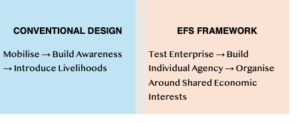
The sequence begins not with a meeting, but with a market entry. A small enterprise pilot — designed for low risk, rapid feedback and genuine market exposure — is introduced at the outset of programme engagement. The deliberate choice of starting small is important: it is not about economic transformation at scale, but about generating a concrete, personalised experience of enterprise that becomes the foundation for deeper engagement.
From this initial engagement, several things tend to happen simultaneously and quickly. Participants develop practical risk awareness — not the abstract understanding that markets are uncertain, but the lived experience of navigating that uncertainty. They begin to negotiate - with suppliers, customers, peers. They build confidence that is grounded in income and performance rather than attendance and affiliation. And through this process, natural leaders begin to emerge — not those most willing to speak at meetings, but those most capable of sustained productive action.
From Linear Ladders to Agency Loops
Perhaps the most significant conceptual contribution of the EFS framework is its move away from the linear ladder model that has long dominated development theory towards what might better be described as an agency loop.
A linear model assumes that change follows a sequence of discrete stages, each building on the last, each requiring completion before the next can begin. The EFS framework suggests that in practice, particularly in market-exposed communities, the relationships between enterprise, agency, collective interest, and social action are not sequential but recursive.
Enterprise builds individual agency. Individual agency generates economic stake. Economic stake drives the formation of collective interest — because individuals with something at stake in the market have a concrete incentive to organise around shared concerns: infrastructure, credit access, fair pricing, regulatory protection. Collective interest, once organised, catalyses social action. And sustained social action, over time, strengthens the enterprise ecosystem from which the loop began.
"A loop. Not a ladder. When we mis-sequence, we exhaust energy. When we align with behavioural reality, momentum compounds."
This reframing has practical consequences. It suggests that enterprise intervention at the start of a programme is not premature — it is generative. It creates the conditions of engagement that mobilisation-first approaches have historically tried, and sometimes failed, to manufacture through awareness campaigns and group formation exercises.
IV. Evidence from Practice
The Enterprise-First Sequencing Framework emerges from field observation, not from randomised control trials or large-n comparative studies. This is an honest caveat. The evidentiary base for this argument, at this stage, is experiential rather than experimental.
But experiential evidence in development has a legitimate and important place. It is the form of knowledge most likely to surface what survey instruments miss: the micro-dynamics of community engagement, the points at which energy accumulates and the points at which it drains away, the texture of leadership emergence and the conditions under which commitment deepens or evaporates.
The pattern observed across multiple programme contexts at Kushal India is consistent. Where mobilisation-first models created engaged, articulate communities that subsequently stalled at the enterprise stage — unable to translate civic energy into economic action — enterprise-first interventions created a different dynamic. Economic engagement came first. Social organising followed, driven not by facilitated awareness-raising but by the organic recognition of shared interest among individuals who now had a material stake in their collective circumstances.
Women who entered small trade were more likely, not less likely, to assert themselves in household decision-making. Small entrepreneurs were more likely to demand infrastructure and fair regulation once their livelihoods depended on them. Producer groups who had achieved market traction were more effective advocates, because they were advocating from a position of demonstrated competence and economic relevance rather than rights-based grievance alone.
This is not an argument that enterprise is the only pathway, or the best pathway in all circumstances. There are contexts — rights-denied environments, communities under active repression, situations of acute crisis — in which mobilisation must lead. The EFS framework is not universal; it is contextually specific. But the conditions under which it applies are, this paper argues, considerably more common than conventional development design has assumed.
V. Implications for Policymakers and Funders
If the EFS framework holds — even partially, even in a subset of contexts — the implications for development institutions are significant. Three areas of practice require direct attention.
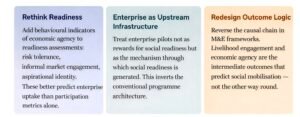
Rethinking Readiness
The first and perhaps most fundamental implication concerns how readiness is defined and measured. Current practice typically operationalises community readiness through participation indicators: group formation rates, meeting attendance, degree of representation, quality of collective voice. These are, at best, indirect proxies for the capacity to engage productively with enterprise.
An EFS-informed approach to readiness assessment would add a set of behavioural indicators focused on economic agency: evidence of risk tolerance, existing market engagement (even informal and small-scale), demonstrated initiative in livelihood experimentation, and the presence of aspirational identity orientations. These are the signals, this paper argues, that better predict enterprise uptake and, downstream, durable social mobilisation.
Enterprise as Upstream Infrastructure
A second implication concerns programme architecture. In most current design, enterprise and livelihoods components are positioned downstream of social preparation activities. They are the culminating intervention, introduced once the social foundations are in place. This positioning reflects the mobilisation-first orthodoxy and replicates its logic in programme structure.
An enterprise-first approach would invert this. Enterprise pilots would be treated not as rewards for social readiness but as upstream infrastructure — as the mechanism through which social readiness itself is generated. This is a consequential design shift. It changes the timing, sequencing and relative resourcing of programme components. It changes the relationship between social facilitation and economic programming. And it changes the theory of change on which proposals to funders are constructed.
Redesigning Outcome Logic
The third implication is for outcome frameworks and evaluation logic. Current monitoring and evaluation practice in community development typically positions social indicators — group formation, collective action, rights awareness — as intermediate outcomes that should precede and predict livelihood outcomes. The EFS framework suggests that for many contexts this causal logic should be reversed: livelihood engagement and economic agency are the intermediate outcomes that predict social mobilisation.
This matters for funding, because it challenges the assumption — common across donors and government programmes alike — that consciousness must precede commerce. Funders who require evidence of social mobilisation before approving livelihoods investment are, from an EFS perspective, conditioning their support on an intermediate outcome that enterprise itself might generate more efficiently. The sequencing requirement in the funding architecture may itself be a constraint on programme effectiveness.
VI. Boundaries and Honest Caveats
Any framework that challenges a durable orthodoxy carries the risk of overclaiming. The EFS framework is not immune to this risk, and intellectual honesty requires its acknowledgment.
First, the framework is not a critique of markets per se. Markets can exclude, exploit and reproduce inequality as readily as they can generate agency. The enterprise-first sequence proposed here is not a route to market fundamentalism. Safeguards matter — access to affordable credit, protection from predatory intermediation, labour protections, and environmental standards. Enterprise without these safeguards can deepen precarity rather than alleviate it. The framework's claim is about sequence and catalyst, not about the sufficiency of markets as development instruments.
Second, the framework is explicitly context-bound. In rights-denied environments — where structural exclusion, caste discrimination, gender violence, or active political repression constrain the conditions for individual agency — mobilisation may not merely be preferable to enterprise as a starting point; it may be a precondition for enterprise to be possible at all. The EFS framework is most persuasively applicable in aspirational communities with meaningful market exposure and at least partial access to the conditions required for individual economic action.
Third, the evidential basis for the framework is, at this stage, practitioner observation rather than systematic research. The proposition advanced here deserves empirical testing across a range of contexts, with the methodological rigour appropriate to a theory of change of this significance. This paper is an invitation to that research conversation, not a claim to have concluded it.
VII. Towards a Research and Practice Agenda
If the Enterprise-First Sequencing Framework is to move from practitioner insight to policy-relevant evidence, several priorities present themselves.
Comparative programme evaluations are needed that explicitly test sequencing as a variable — controlling for community characteristics, sector, and facilitating organisation, and comparing enterprise-first and mobilisation-first approaches in matched contexts. This is methodologically challenging but not impossible, and the absence of such studies is itself revealing.
The measurement of economic identity as a community-level variable deserves more systematic attention. If aspirational economic identity is, as this paper argues, a better predictor of enterprise uptake and downstream social mobilisation than conventional participation indicators, it should be measurable — and its measurement could substantially improve programme targeting and design.
There is also a need for more honest reflection within the development sector about how funding architecture may inadvertently perpetuate sequencing orthodoxies that the evidence does not fully support. Institutional incentives shape the theories of change that practitioners advance in proposals, often independently of what field experience suggests. Creating the conditions for that experience to be surfaced and genuinely incorporated into design guidance is a governance challenge, not just a technical one.
VIII. Conclusion: Sequence as a Design Variable
Development practice has been shaped by many orthodoxies, most of them well-intentioned and some of them well-founded. The proposition that communities must first be mobilised before they can productively engage with enterprise is one of the most durable — and one of the least rigorously examined.
The Enterprise-First Sequencing Framework does not argue that this orthodoxy is wrong in all contexts. It argues that it is wrong in more contexts than current practice assumes, and that its persistence as the default design logic has costs: stalled programmes, exhausted facilitators, communities mobilised into articulacy and then left unable to translate that articulacy into economic action.
The deeper contribution of this framework is perhaps its simplest: the insistence that sequence is a design variable. Not only what we do in development, but when we do it. The order of operations in a programme is not merely logistical; it is substantive. It shapes what kinds of leaders emerge, what kinds of commitment are generated, and what kinds of change prove durable.
Economic agency reshapes identity. Identity reshapes expectations. Expectations drive collective action. In many contemporary communities, the most effective path to durable social change may begin not with a meeting, but with a market.
"If we want durable change, we must be willing to question not just our tools, but our order of operations."
About the Author
Sujit Ghosh is a UK-based social entrepreneur and the founder of Kushal India, an organisation working at the intersection of enterprise development and community change in India. This framework emerges from sustained field practice and observation across aspirational communities navigating informal economies and social transition.
Key Concepts and References
Enterprise-First Sequencing (EFS) Framework — Sujit Ghosh / Kushal India (2026)
Pedagogy of the Oppressed — Paulo Freire (1968): foundational text for the mobilisation-first orthodoxy critiqued in this paper.
Development as Freedom — Amartya Sen (1999): capabilities approach to agency as constitutive of, not merely produced by, development.
Skin in the Game — Nassim Nicholas Taleb (2018): the behavioural economics of authentic commitment under conditions of risk.
The Will to Improve — Tania Murray Li (2007): examination of how development programmes construct community subjects and the limits of that construction.